Best Temples in Thailand
Thailand is not only about islands, beaches, street food, and night markets, but also a country where temple culture is part of everyday life. Thailand is often seen as a land of resorts and “easy vacation vibes”, yet it has another strong side: living Buddhist temples that still set the rhythm of cities and villages, and ancient capitals with ruins that feel like an open-air museum of history.
In a single trip, you can watch monks collecting alms at dawn, step into a quiet courtyard filled with incense and bells, then finish the day at a golden chedi glowing in the sunset light. Here “temples” can be an elegant urban complex with murals and carved roofs — or a centuries-old stupa in a former royal city, surrounded by bricks, banyan trees, and silence.
Famous Temples in Thailand: What to See First
The most famous in the country:
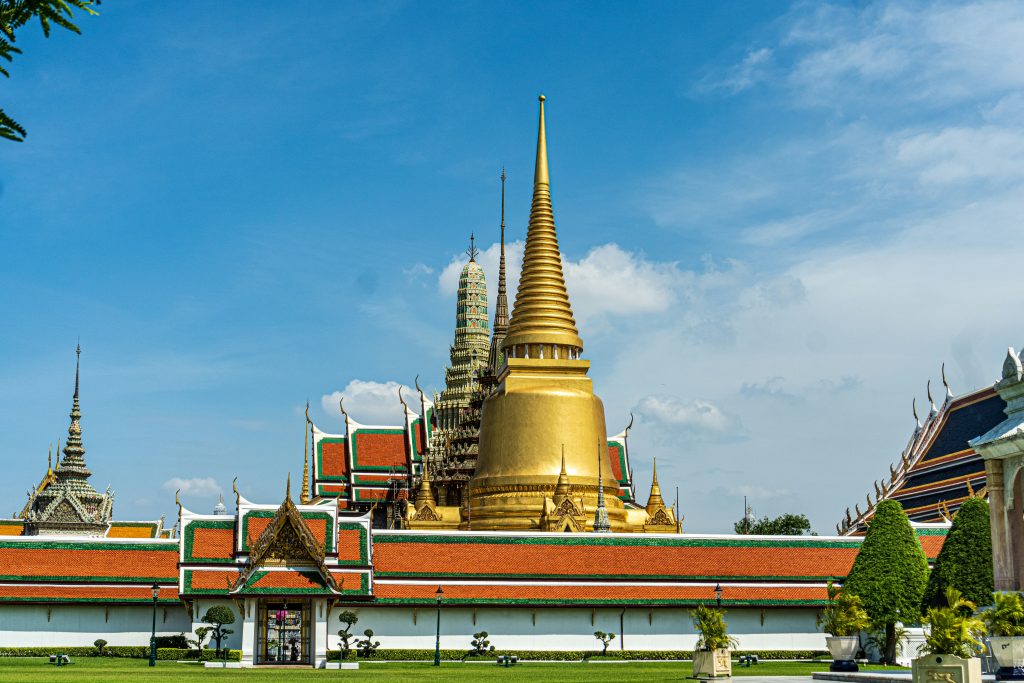
- Wat Phra Kaew (Temple of the Emerald Buddha), Bangkok — the main symbol of royal Thailand and the country’s most prestigious shrine (within the Grand Palace complex).
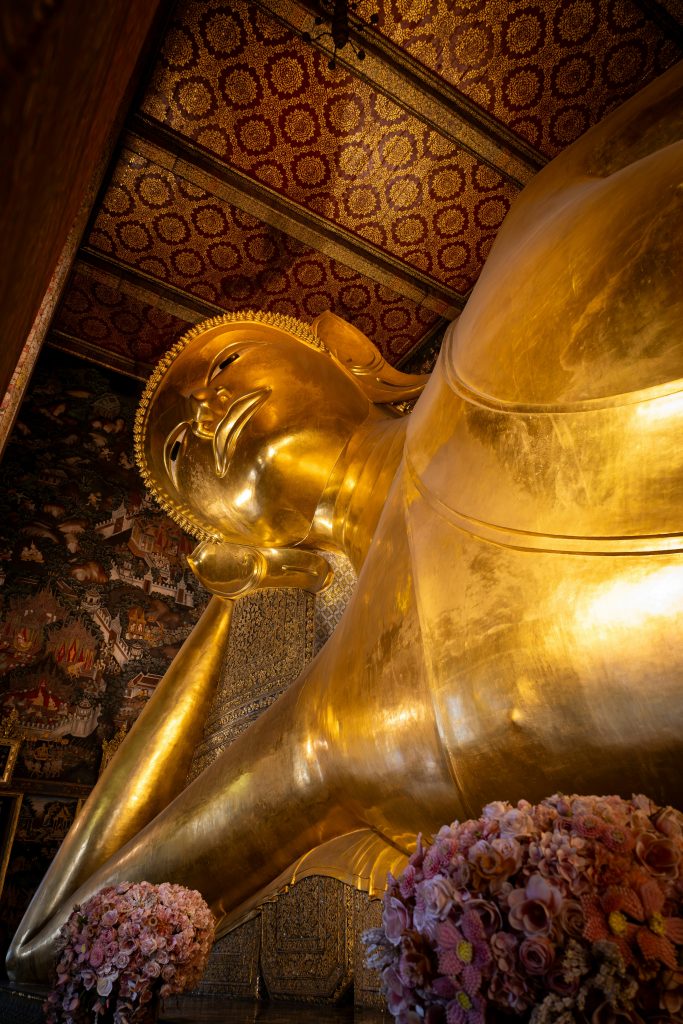
- Wat Pho, Bangkok — the giant Reclining Buddha + classic halls with murals and that “old Bangkok” feeling.
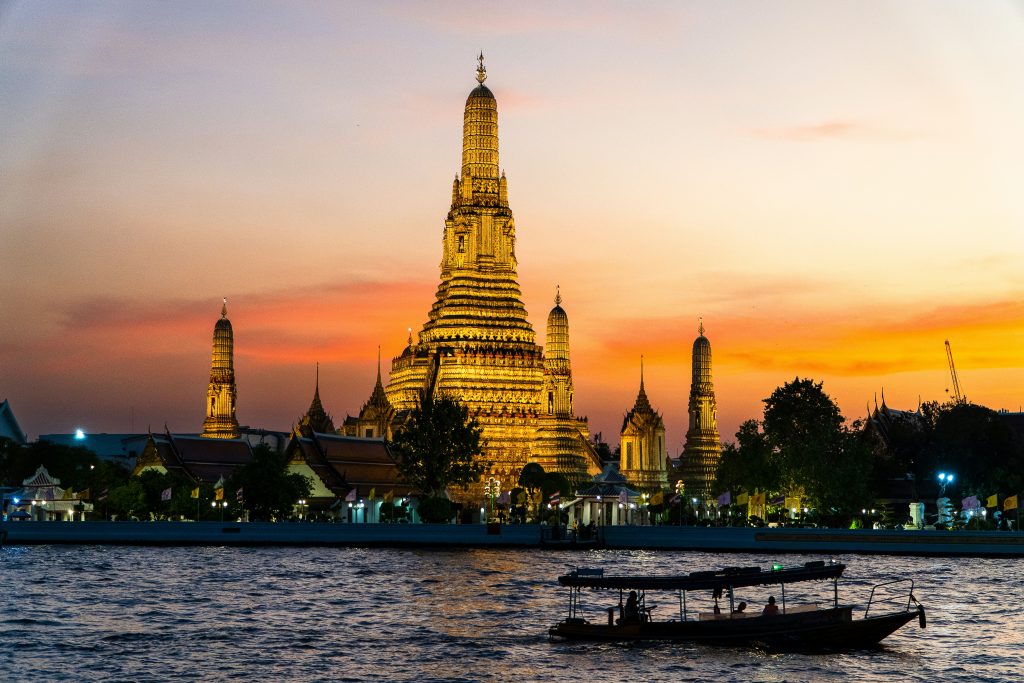
- Wat Arun, Bangkok — a tall prang tower covered in ceramic mosaic; the best “wow effect” is closer to sunset from the riverside.
The most atmospheric:
- Wat Phra That Doi Suthep, Chiang Mai — a climb up the mountain, steps/views, and the feeling that you came here “with a purpose,” not just to look around.
- Wat Rong Khun (White Temple), Chiang Rai — a modern temple-gallery full of symbolism and unexpected details.
- Ayutthaya (temple ruins in the Historical Park), Ayutthaya — a walk among brick chedis of the former capital: more about scale and history than decoration.
The most ancient:
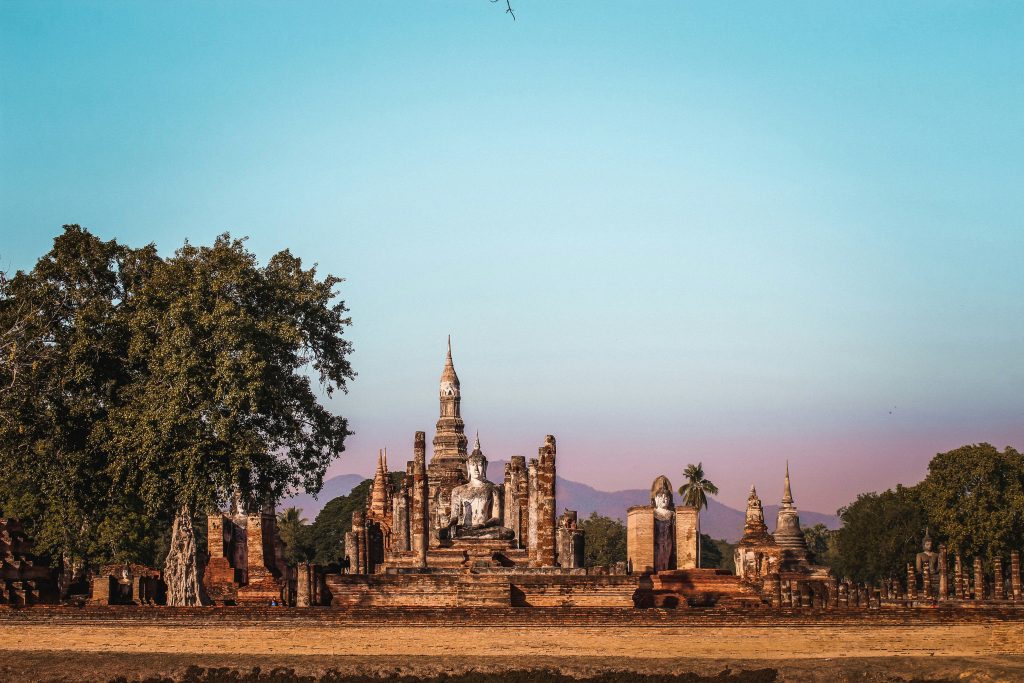
- Sukhothai Historical Park, Sukhothai — early Thai style: clean silhouettes, ponds, and Buddha statues.
- Wat Mahathat, Ayutthaya — one of the key temples of the ancient capital and its most recognizable image.
- Phanom Rung (Prasat Phanom Rung), Buriram — a Khmer temple on a volcano.
Best if you have little time:
Wat Phra Kaew → Wat Pho → Wat Arun (a logical combo: palace / classics / river panorama).
Best in the capital / near the capital:
- Wat Phra Kaew, Bangkok — the number one choice if it’s your first time in Thailand.
- Ayutthaya — the easiest way to add “ancient Thailand” without complicated travel.
Best “outside the tourist classics”:
- Wat Chaloem Phra Kiat (Lampang area) — more about views than a city-style sightseeing stop.
- Wat Rong Suea Ten (Blue Temple), Chiang Rai — a vivid modern temple that usually feels easier and quicker than the “White” one.
How many days do you need for temples on a first trip?
2-4 days total (depending on whether you stick to Bangkok and nearby spots or add the North).
The Best Temples in Thailand
Bangkok and nearby
- Wat Phra Kaew
Thailand’s main royal shrine within the Grand Palace complex; the site of state religious ceremonies. The Emerald Buddha statue is small (about 66 cm), and three times a year it is ceremonially “changed” into different gold robes for the seasons.
Location: Bangkok, Phra Nakhon (Grand Palace).
How to visit: independently; it’s easiest to arrive early and follow the route palace → temple.
Time needed: 1-2 hours.
Best time: mornings, weekdays.
Tickets/donation: paid (Grand Palace combined ticket).
- Wat Pho
One of the key temples of old Bangkok, famous for the Reclining Buddha. The temple preserves 1,431 stone inscriptions — an encyclopedia of knowledge of its time; the archive is listed in UNESCO’s Memory of the World programme.
Location: Bangkok, near the Grand Palace.
How to visit: independently.
Time needed: 1-2 hours.
Best time: morning or late afternoon.
Tickets/donation: paid.
- Wat Arun
One of the country’s most recognizable temples; a dominant silhouette on the Chao Phraya River. The main prang is considered the largest “prang-chedi” of its type; UNESCO’s tentative listing notes a height of 61.20 m and a unique glazed porcelain decoration characteristic of this monument.
Location: Bangkok, west bank of the Chao Phraya.
How to visit: independently; convenient by river transport/ferry.
Time needed: 45-90 minutes.
Best time: sunset for views and light; morning if avoiding crowds matters more.
Tickets/donation: paid.
The North: Chiang Mai and Chiang Rai
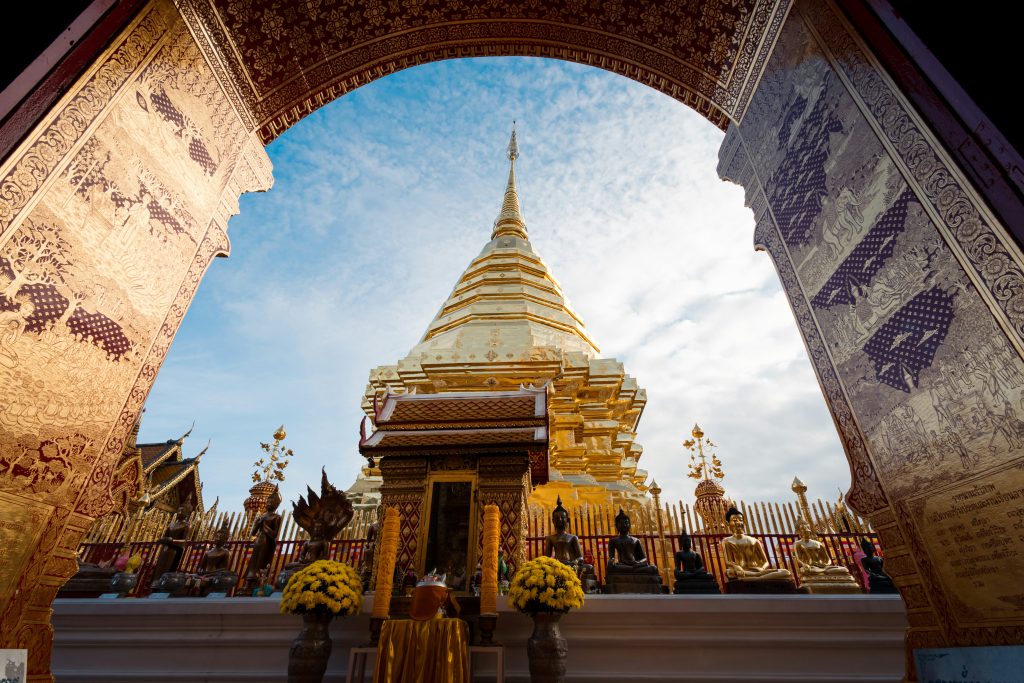
- Wat Phra That Doi Suthep
One of the major northern shrines; a “mountain temple” with views over Chiang Mai. Its location is tied to the legend of a white elephant that carried a Buddha relic, climbed the mountain, and stopped exactly here.
Location: near Chiang Mai (Doi Suthep).
How to visit: songthaew/taxi or a tour.
Time needed: 1-2 hours.
Best time: mornings, weekdays.
Tickets/donation: usually paid + optional donations.
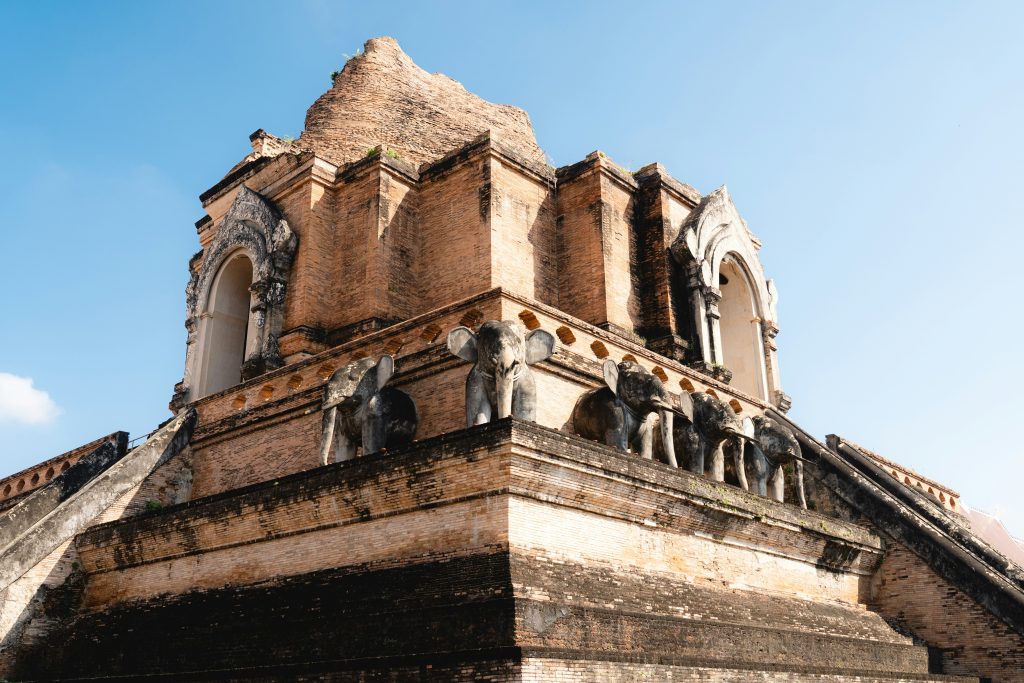
- Wat Chedi Luang
The most “monumental” temple in the Old City; a strong snapshot of Lanna-era power. The chedi once reached 82 m, but its upper part collapsed after an earthquake (often dated to 1545). In the 15th century, the Emerald Buddha was temporarily kept here.
Location: Chiang Mai, Old City.
How to visit: on foot in the city center.
Time needed: 45-90 minutes.
Best time: morning or closer to evening.
Tickets/donation: usually paid/donation (depending on site rules).
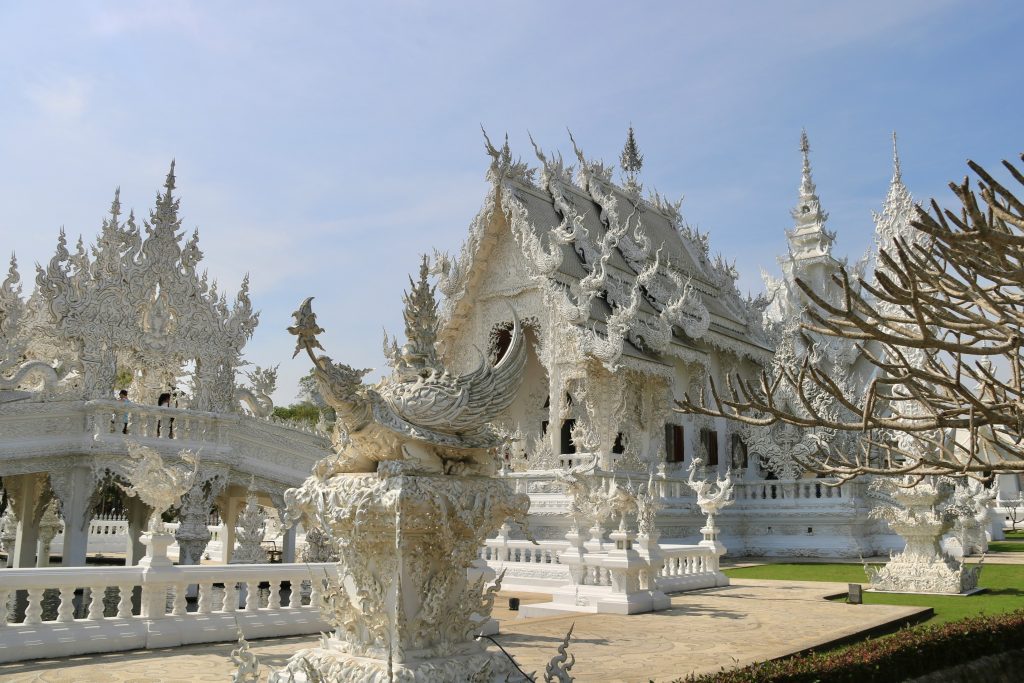
- Wat Rong Khun (White Temple)
Thailand’s most famous “modern temple”; visually nothing like the classics. The white color and mirror inlays symbolize purity and enlightenment, and the approach to the main building is designed as a “path” through symbolic trials.
Location: Chiang Rai (suburbs).
How to visit: bus/taxi or a tour.
Time needed: 1-2 hours.
Best time: right at opening.
Tickets/donation: usually paid.
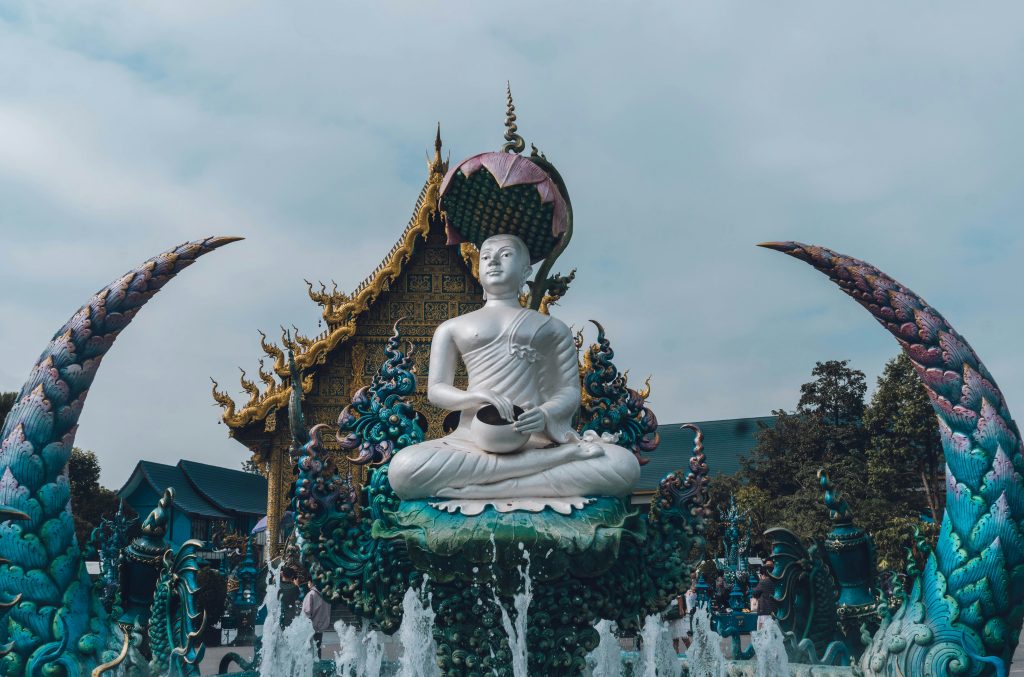
- Wat Rong Suea Ten (Blue Temple)
A vivid modern temple that’s easy to add to a Chiang Rai day.
Location: Chiang Rai.
How to visit: taxi/songthaew or a tour.
Time needed: 30-60 minutes.
Best time: weekday mornings.
Tickets/donation: usually donations.
Central Thailand: Sukhothai
- Sukhothai Historical Park
One of the country’s key historical complexes; early “Sukhothai style” and a calm park format. It’s part of the UNESCO World Heritage site Historic Town of Sukhothai and Associated Historic Towns (since 1991). The area is large — descriptions mention dozens/hundreds of ruins — and it’s convenient to explore by bicycle.
Location: Sukhothai.
How to visit: independently (bike/electric cart) or a tour.
Time needed: half a day to a full day.
Best time: early morning or late afternoon.
Tickets/donation: paid.
Northeast: Isan
- Phanom Rung Historical Park (Prasat Phanom Rung)
A Hindu temple complex; a different cultural layer compared to Bangkok and the North. Fun fact: it’s known for the “sun corridor” phenomenon — sunrise aligns through 15 doorways on specific days (usually a few dates in April and in September).
Location: Buriram province.
How to visit: easiest by car/taxi.
Time needed: 1-2 hours.
Best time: mornings, weekdays.
Tickets/donation: paid.
The South
- Wat Chalong (Phuket)
The island’s best-known temple; an easy, straightforward stop for a short visit between beaches and viewpoints.
Location: Phuket.
How to visit: taxi/scooter or an island tour.
Time needed: 45-90 minutes.
Best time: morning.
Tickets/donation: usually donations.
- Wat Phra Yai (Koh Samui)
Samui’s main landmark; easy to visit and fits well into an island itinerary.
Location: Ko Fan (near Samui).
How to visit: taxi/scooter or an island tour.
Time needed: 30-60 minutes.
Best time: morning or sunset.
Tickets/donation: usually donations.
Suggested temple itineraries
Option A: 3-4 days
Regions covered
Bangkok + Ayutthaya (maximum impact with minimal travel).
Travel logic
Day 1 — Bangkok, Old Town: Wat Phra Kaew → Wat Pho (same area; easy to walk between them).
Day 2 — Bangkok: Wat Arun + a walk/ferry crossing on the Chao Phraya (the temple works best as a short, separate outing).
Day 3 — Ayutthaya: day trip for the ruins (Wat Mahathat and the key complexes in the Historical Park).
Day 4 (optional) — buffer day: either a second Ayutthaya day (if you want more ruins without rushing), or return to one of Bangkok’s temples early for photos/a calmer visit.
Transfers and the best base
- Transfers: 1 main out-and-back trip Bangkok → Ayutthaya → Bangkok (as a day trip).
- Base: stay in Bangkok the whole time — the simplest plan with no hotel changes.
Option B: 7-10 days
Regions covered
Bangkok + Ayutthaya → The North (Chiang Mai/Chiang Rai) → (optional) Sukhothai.
This is the combo where you get the royal “showcase,” ancient capitals, and the northern Lanna tradition — without feeling like you’re constantly on the move.
Travel logic
Bangkok (2-3 days):
- One day for the Old Town “core”: Wat Phra Kaew + Wat Pho.
- Separate slot for Wat Arun (a short outing / evening plan).
Ayutthaya (1 day):
- Day trip from Bangkok (or an overnight if you want a slower pace).
Chiang Mai (2-3 days):
- In the city: Wat Chedi Luang (plus 1-2 more temples if you want, without overloading).
- Separate outing: Doi Suthep (best as a morning/half-day).
Chiang Rai (1-2 days):
- Wat Rong Khun (White Temple) + Wat Rong Suea Ten (Blue Temple) — two very different styles in one day.
Sukhothai (optional, 1 day):
- Add it between Bangkok and the North, or “slot it in” en route if you’re okay with an extra transfer for the historical park.
Transfers and the best bases
Transfers (without Sukhothai): usually 2 main moves — Bangkok → Chiang Mai and Chiang Mai → Chiang Rai (then back/forward depending on your plan).
Bases:
- Bangkok (2-3 nights)
- Chiang Mai (2-3 nights)
- Chiang Rai (1-2 nights)
If you add Sukhothai: you’ll have one extra base change for 1 night (or a long day transfer), but the park often feels worth it if you want “ancient Thailand” beyond Ayutthaya.
Temple etiquette
Dress code
In most Thai temples, clothing that covers shoulders and knees is expected for both men and women, so strappy tops, short shorts, and mini skirts are best saved for the beach. For “all-day” routes, it’s convenient to carry a light overshirt and a sarong/pareo — this way you can enter a temple easily even if you stop by on the go. In the most visited places, especially in Bangkok, the rules are usually stricter, so it’s better to plan your outfit from the start to avoid wasting time changing and to avoid being turned away at the entrance.
How to behave inside
In temple halls and near altars, it’s important to speak quietly and not disturb those who came to pray: don’t block walkways, don’t stand for a long time in front of people performing a ritual, and keep some distance. Shoes are removed before entering indoor areas — the rule of thumb is simple: if there are rows of shoes by the door, everyone takes theirs off. When sitting inside, try not to point your feet toward Buddha images or the altar; if you’re unsure what’s correct, the easiest approach is to copy locals and sit sideways with your legs tucked in. A separate point is contact with monks: for women, it’s usually not appropriate to touch monks or hand items directly to them, so if you need to pass something, it’s better to use a basket or place the item on a surface.
Photos and video
Photography is usually allowed on temple grounds, but inside the main halls the rules depend on the specific place: if you see a “No photo/No video” sign, it should be respected. Even when filming is allowed, it’s best to avoid close-ups of people during prayer and rituals — especially funerals or memorial ceremonies — so it’s safer to stick to wide shots without faces or simply move on. Drone filming in cities and near temples is often regulated separately, so if it matters for your trip, it’s best to check the rules in advance.
If you’re visiting with children
With kids, it helps to explain a few simple rules ahead of time: inside temples we speak quietly, we don’t run, and we don’t touch items near the altars — this keeps the visit calm and avoids comments from staff. In a hot climate children get tired faster, so it’s useful to bring water and plan short breaks, while keeping snacks for outside, since there may be restrictions inside the halls. If the goal is a low-stress introduction to “temple Thailand,” it’s often easier to start with historical parks (Ayutthaya/Sukhothai), where there’s more space and a walk-friendly format than in strict palace complexes.
Practical tips for visiting temples in Thailand
How to avoid crowds
The most reliable way to see temples in a calmer mood is to arrive at opening time or in the first half of the day: mornings bring fewer tour groups, softer light, and heat that’s easier to handle. If you can choose, Bangkok’s most popular spots (the Grand Palace/Wat Phra Kaew, Wat Pho, Wat Arun) are best planned for weekdays, because weekends are noticeably busier — and in high season, lines can start forming by mid-morning. The same principle works for historical parks like Ayutthaya and Sukhothai: start early, take breaks during the hottest hour, and return to the most “photogenic” points closer to evening, when some visitors have already left.
Weather and footwear
In Thailand, temple visits often involve a lot of walking on stone and tiles, and in the rainy season surfaces become slippery — especially on steps and around chedis — so it’s best to choose shoes with good grip and a non-slip sole. Midday can be very hot and humid, and in open areas (Ayutthaya, Sukhothai, Phanom Rung) there’s little shade, so a simple formula helps: carry water, wear a hat, choose light but covering clothing for sun protection, and leave extra time so you don’t have to rush between sites. If your plan includes climbing stairs (for example, at mountain temples or terraces), keep in mind that after rain the ascents become noticeably harder — so it’s better to schedule those visits for the morning and keep an eye on the forecast.
Accessibility (stairs, long walks)
Many temples and historical complexes aren’t designed for perfect accessibility: you’ll often see high thresholds, steep staircases, and long walking loops with few benches or shade. If you have limits on how much you can walk, it’s better to focus on places where you can control pace and distance: in Bangkok, that means temples you can easily reach by taxi/boat and visit in 45-90 minutes, while in historical parks it’s often more comfortable to move around by bicycle, electric cart, or with a tuk-tuk as a “transfer” between key sites. For mountain temples and viewpoints, build in extra time in advance and plan rest stops halfway — this keeps the visit comfortable and avoids fatigue.
Common tourist scams near major sites
Around the most visited temples — especially in Bangkok — you may run into the classic “helpful local” who says the temple is supposedly closed “for a ceremony/holiday” and then offers an alternative tuk-tuk route, a “shop stop” on the way, or a boat ride at an inflated price. In most cases, it’s simply an attempt to steer you into a paid trip. The best approach is not to argue, but to calmly verify information at the official entrance or with security, and to use straightforward transport channels: river piers, official ticket booths, and Grab/taxis with a tracked price. Also be cautious with “super cheap” tours that don’t clearly list the route, and with strangers offering “skip-the-line” tickets — at popular sites it’s safer to buy tickets at the official booth or official points, and to confirm prices and rules from on-site signage.
Final Thoughts
Temples in Thailand are one of those cases where cultural sightseeing doesn’t turn into a box-ticking exercise. The tradition here is alive: in active temples, prayers and rituals are happening every day, while in the ruins of former capitals you can feel the scale of history without that “museum distance.”
To keep your first trip comfortable, don’t try to see everything. Pick a base in one or two regions: a few key temples in Bangkok, one day trip to Ayutthaya or Sukhothai, and — if you have time — the North (Chiang Mai/Chiang Rai). If you go in the morning, schedule the most popular places on weekdays, and leave a bit of buffer time, the trip will be remembered not for exhaustion, but for the atmosphere of Thailand.